
As an integral component of fiber optic cables, fiber optic connectors come in various types and configurations. With an assortment of options to choose from, it might get overwhelming to decide which connector is the most suitable for your needs. In this comprehensive guide, we classify fiber optic connector types based on various standards such as utilization, fiber count, fiber mode, transmission method, boot length, polishing type, and termination method. Whether you're operating a data center or setting up an enterprise network, our guide will help you navigate through the complex world of fiber optic connectors to find your perfect match.
Several fiber connectors like LC, SC, MTP, MPO, and ST require an adapter panel for connection. These connectors are common in data centers, telecom rooms, and enterprise networks. Let's dive deeper into these types:
| Connector Type | Description |
|---|---|
| LC Connector | Lucent Connector (LC) is a small form factor (SFF) connector with a 1.25mm ferrule. Its small footprint makes it ideal for high-density applications, and it's the most commonly used connector today. |
| SC Connector | SC fiber connector, or "Square Connector," is a snap-in connector with a 2.5mm ferrule. It's well-suited for datacom and telecom applications and remains the second most common connector for polarization maintaining applications. |
| MTP/MPO Fiber Connector | MTP/MPO fiber connector is a multi-fiber connector that combines 12 to 24 fibers in a single rectangular ferrule. It's typically used in high-bandwidth optical parallel connections. |
| ST Connector | ST (Straight Tip) connector holds the fiber with a ceramic, spring-loaded 2.5mm ferrule. It's commonly used in long and short distance applications such as campuses and building multimode fiber applications. |
| FC Connector | FC (Ferrule Connector) was the first to use a ceramic ferrule. It utilizes a round screw-type fitment, often made from nickel-plated or stainless steel. Despite its complexity, FC connectors are still a choice in precision instruments. |
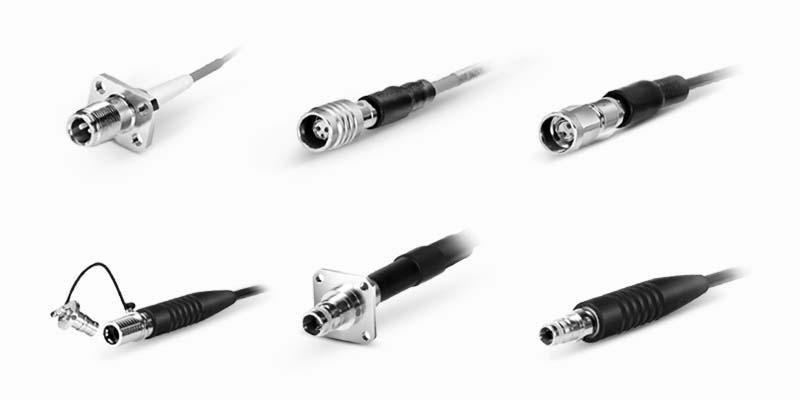
Unlike the above types, the Rosenberger Q-RMC and NEX10 connectors can connect without using an adapter panel, designed for harsh environments. Here's more about these connectors:
| Connector Type | Description |
|---|---|
| Rosenberger Q-RMC Connector | Q-RMC or Rosenberger Multifiber Connector is a robust industrial connector holding up to 24 fiber cores. It's quick to install even in tight areas and withstands extreme temperatures, ideal for industrial sites, mine fields, mobile communication (FTTA), and more. |
| Rosenberger NEX10 Connector | NEX10 connector, perfect for harsh outdoor environments, is compact, waterproof, dustproof, and anti-corrosion. It's commonly used in small sells, distributed antenna systems(DAS), in-building architecture, and MIMO. |
While simplex connectors allow signals to travel only in one direction, duplex connectors enable signals to travel both ways. Let's compare:
| Connector Type | Description |
|---|---|
| Simplex Connector | Simplex connection means signals are sent in one direction. A simplex fiber optic connector connects with one strand of glass or plastic fiber. |
| Duplex Connector | D uplex connection means signals can go both ways (bi-directional). A duplex fiber optic connector links two fibers, allowing for simultaneous, bi-directional data transfer. |
Single mode fiber connectors transmit light through a single path, while multimode connectors have larger cores that enable multiple paths for light. Here's a comparison:
| Connector Type | Description |
|---|---|
| Single Mode Connector | Single mode connectors are typically used in long-haul network connections, with lower attenuation and higher bandwidth capacity. |
| Multimode Connector | Multimode connectors are used for short distance transmission, like within a building or on a campus, and typically operate at 850nm or 1300nm. |
Address : 5F,Zhongshunyiquan Industry Park, Fuqian Road,Longhua District, Shenzhen, China
Address : 5F,Zhongshunyiquan Industry Park, Fuqian Road,Longhua District, Shenzhen, China
Tel : +86-755-23771707
Whatsapp : +86 13544277727
Email : sales@gezhi.net
Skype : 13544277727
Copyright Gezhi Photonics Co.,Ltd. All rights reserved.


