
Internet routing protocols, specifically OSPF (Open Shortest Path First) and BGP (Border Gateway Protocol), form the backbone of modern Internet operations. While both of these protocols help guide traffic over the Internet, their functionality and use cases differ significantly. This article will delve into the intricacies of both OSPF and BGP, outlining their unique features, strengths, weaknesses, and how they work together to create an efficient and responsive network system.
The principal difference between OSPF and BGP lies in their operational spheres. OSPF is an intra-domain (internal) routing protocol using link state routing, meaning its primary function is performed within an autonomous system (AS). In contrast, BGP is an inter-domain (external) routing protocol using path vector routing, and its primary function is performed between two autonomous systems.
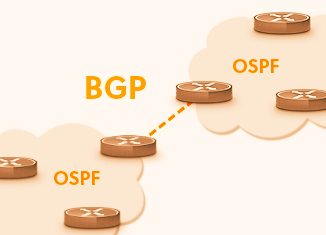
To help you visualize the differences between OSPF and BGP, here is a comparison chart:
| Features | OSPF | BGP |
|---|---|---|
| Gateway Protocol | Internal gateway protocol | External gateway protocol |
| Configuration | Easier to configure | Complex |
| Convergence Rate | Fast | Slow |
| Topology | Hierarchical | Meshed |
| Resource Requirements | Memory and CPU Intensive | Depends on routing table size |
| Network Size | Primarily for smaller, centrally administered networks | Primarily for large-scale networks (e.g., the Internet) |
| Routing Preference | Fastest route | Best path |
| Algorithm Used | Dijkstra Algorithm | Best Path Algorithm |
| Protocol Used | Internet Protocol (IP) | Transmission Control Protocol (TCP) |
The chart highlights the differences in network design, resource requirements, protocol preferences, and other aspects of OSPF and BGP. The information helps to understand where and why these protocols are implemented, and how they impact the overall network performance.
Choosing between OSPF and BGP hinges on the specific needs of your network. In a nutshell, if you're conducting internal routing within a site, company, or campus, OSPF should be your protocol of choice, as it is ideally suited for internal network routing. Conversely, if your network needs involve building inter-site connections, BGP proves more beneficial. In fact, most service providers opt for BGP to carry customers' routes.
It's important to mention that OSPF and BGP are not competitors. Instead, they are often used in conjunction, harmonizing internal and external network routing. In most data centers, OSPF is typically used for internal routing, while BGP takes over when the traffic needs to cross to another organization, such as to an MPLS network with other sites or to the Internet.
Both OSPF and BGP play a crucial role in maintaining the smooth operation of the Internet and various networks. While OSPF's fast convergence makes it ideal for internal routing within an autonomous system, BGP's scalability and path preference capabilities prove essential for routing across multiple autonomous systems. They do not serve as alternatives to each other but instead complement each other's capabilities to ensure efficient and responsive network operations.
Address : 5F,Zhongshunyiquan Industry Park, Fuqian Road,Longhua District, Shenzhen, China
Address : 5F,Zhongshunyiquan Industry Park, Fuqian Road,Longhua District, Shenzhen, China
Tel : +86-755-23771707
Whatsapp : +86 13544277727
Email : sales@gezhi.net
Skype : 13544277727
Copyright Gezhi Photonics Co.,Ltd. All rights reserved.


