
Power over Ethernet (PoE) technology is a significant advancement in network infrastructure, combining power and data delivery into a single Ethernet cable. The application of PoE, from powering IP cameras to wireless access points, simplifies the complexity of cable management, eliminates the need for separate power sources, and reduces installation costs. In implementing PoE, there are two main methods: using a PoE switch or a PoE injector. In this article, we dive into the differences between these two options and provide insight on why a PoE switch might be the better choice for establishing wireless networks.
A PoE switch is a network device that integrates PoE technology into its functionality. This integration allows the switch to supply power directly through the Ethernet cable to connected PoE-enabled devices such as IP cameras, VoIP phones, and wireless access points.
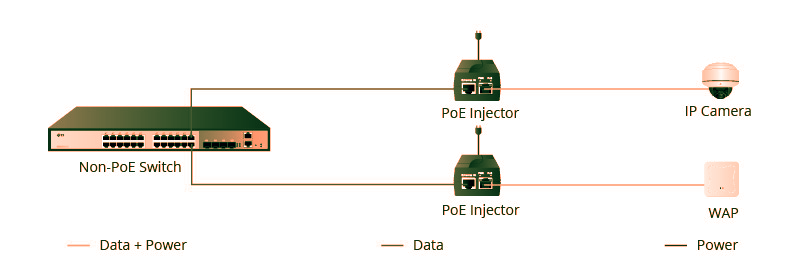
Contrarily, a PoE injector is a standalone device designed to add PoE capabilities to non-PoE network equipment. It sits between the non-PoE switch and the PoE-enabled device, injecting power into the Ethernet cable. The use of an injector introduces an extra step in the setup process, as it must be connected to both the non-PoE network device and the PoE-enabled device.
| PoE Switch | PoE Injector | |
|---|---|---|
| Installation | Requires only one connection to the PoE-enabled device | Needs two connections - to the non-PoE switch and the PoE device |
| Cost | Higher initial cost, but long-term savings due to reduced equipment and simplified management | Lower upfront cost, but potential for higher long-term cost due to the need for additional equipment |
| Scalability | Supports multiple PoE devices, allowing for easier network expansion | Can power only one PoE device, limiting network growth |
| Management | Offers robust network management and control features | Provides no network management features |

When selecting a PoE switch for a wireless network, consider the following factors:
Number of Ports: The number of ports determines how many PoE-enabled devices can connect to the switch.
Power Budget and PoE Standard: These impact the PoE switch's overall power consumption and the types of PoE devices it can support.
Managed or Unmanaged: Managed PoE switches provide additional features such as VLAN support, QoS, SNMP, and more, which can prove beneficial for larger or more complex networks.
Both PoE switches and PoE injectors serve the primary function of providing power to PoE-enabled devices over an Ethernet cable. However, when building a wireless network, a PoE switch is generally the better option. PoE switches are more convenient, cost-effective, scalable, and offer better management features than PoE injectors. Choosing the right PoE solution can significantly enhance your network's efficiency and effectiveness. At Gezhi, we offer a wide range of PoE switches. For detailed information and product availability, visit our website at www.gezhi.com or contact us.
SEO Title: Choosing the Right Power over Ethernet Solution: PoE Switch Vs. PoE Injector - Gezhi
SEO Description: An in-depth comparison of PoE Switch Vs. PoE Injector for building wireless networks. Understand their differences, benefits, and how to choose the right PoE solution for your network with Gezhi.
SEO Keywords: Power over Ethernet, PoE, PoE Switch, PoE Injector, Gezhi, Wireless Networks, Networking Solutions
SEO URL: www.gezhi.com/blog/poe-switch-vs-poe-injector
Address : 5F,Zhongshunyiquan Industry Park, Fuqian Road,Longhua District, Shenzhen, China
Address : 5F,Zhongshunyiquan Industry Park, Fuqian Road,Longhua District, Shenzhen, China
Tel : +86-755-23771707
Whatsapp : +86 13544277727
Email : sales@gezhi.net
Skype : 13544277727
Copyright Gezhi Photonics Co.,Ltd. All rights reserved.


