
Understanding Global Power Cord Standards in Data Centers
For network engineers operating in the interconnected, global environment of modern data centers, an understanding of the diversity in power cord types is critical. Each country has its unique power cord types, plugs, and connectors; therefore, this guide explores the international standard IEC 60320 and other region-specific standards.
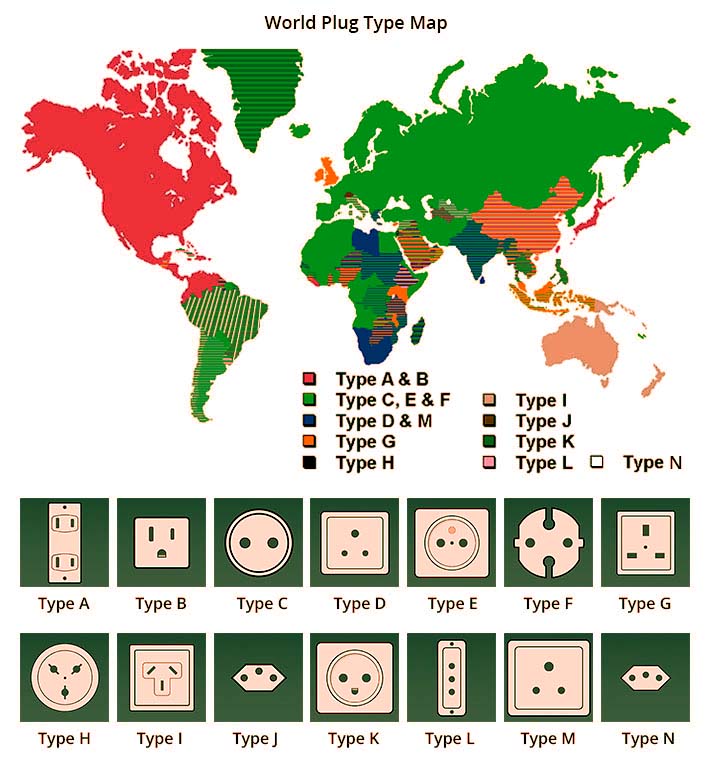
The IEC 60320 is an international standard recognized by most countries worldwide, setting specifications for power cords for appliances up to 250 volts. The designations like "C13", "C15", or "C19" refer to specific connector types defined by IEC 60320. The following table offers details about these common connectors:
| Connector Type | Description |
|---|---|
| IEC C13 | The most common connector, often used with computers and office equipment |
| IEC C15 | Similar to C13 but with a notch, designed for high-temperature environments |
| IEC C19 | Designed for high power connectivity, common in data centers |

In North America and some countries adhering to NEMA standard, the NEMA 5-15P plug is the most widely used. It's a three-wire circuit (hot, neutral, and ground), rated at 15 A at 250 V, but it usually carries 110 V. Some common power cord types with NEMA 5-15P plug include NEMA 5-15P to C13 and NEMA 5-15P to C15.
In Europe, the CEE 7/7 is the de facto plug standard, except in Denmark, Ireland, Italy, Malta, Cyprus, Gibraltar, and Switzerland. Some popular power cords using the CEE 7/7 plug include CEE 7/7 to C13, CEE 7/7 to C15, and CEE 7/7 to C19.
Many countries have their own plug standards, like the Australian standard AS/NZS 3112 (Type I), the Brazilian standard NBR 14136, and the Japanese standard JIS C 8303 (Type A, B). However, they often align with the IEC 60320 connector standard.
Understanding these standards can significantly enhance the network engineers' first-hand experience in foreign data centers, ensuring seamless operations and reducing risks associated with the wrong cord usage.
Please note: You may need to adapt this code to suit the particularities of your webpage's HTML structure. To ensure better results, consult with your web developer or site administrator.
Address : 5F,Zhongshunyiquan Industry Park, Fuqian Road,Longhua District, Shenzhen, China
Address : 5F,Zhongshunyiquan Industry Park, Fuqian Road,Longhua District, Shenzhen, China
Tel : +86-755-23771707
Whatsapp : +86 13544277727
Email : sales@gezhi.net
Skype : 13544277727
Copyright Gezhi Photonics Co.,Ltd. All rights reserved.


