
The connection between network devices is the foundation of modern communication, and optical modules play a vital role in this process. SFP, SFP+, SFP28, QSFP+ and QSFP28 are several common types of optical modules at present, each of which has its own characteristics and uses. So, what is the difference between these optical modules? This article will analyze the characteristics and uses of these optical modules in detail to help you choose the appropriate optical module according to your needs.
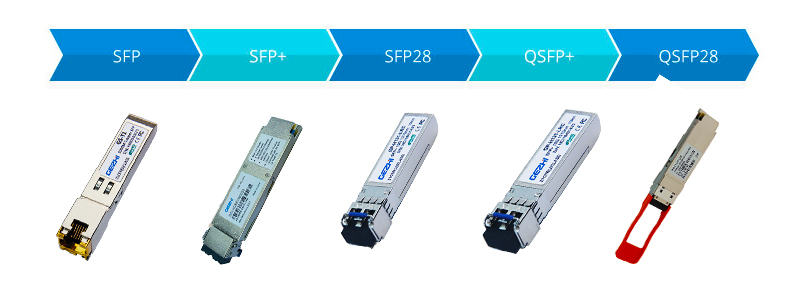
SFP and SFP+ are nearly identical in size and appearance, which allows equipment manufacturers to reuse existing SFP physical designs on SFP+ ports in network switches. However, the transfer speeds they support and the specifications they follow are different. SFP supports a maximum speed of 4 Gbit/s, while SFP+ supports 10 Gbit/s. In terms of specifications, SFP is based on the SFF-8472 protocol, while SFP+ follows SFF-8431 and SFF-8432. In addition, SFP+ ports can usually accept SFP optical modules, but the speed will be reduced to 1 Gbit/s. It is worth noting that the SFP+ module cannot be inserted into the SFP port, otherwise it may damage the product or the port.
Comparison of SFP28 and SFP+
SFP28 is an upgraded version of SFP+, which supports higher transmission speed under the same size. The maximum speed of SFP28 can reach 25 Gbit/s, while the maximum speed of SFP+ is 10 Gbit/s. Also, the connector pins of SFP28 and SFP+ are compatible, so SFP28 can work on SFP+ ports, but the speed will be reduced to 10 Gbit/s. However, if the port of the network switch cannot be set to 10G transmission, the SFP+ module will not work on the SFP28 port.
Comparison of SFP28 and QSFP28
Although both SFP28 and QSFP28 have the number "28" in their names, their dimensions and operating principles are different. SFP28 supports only one 25 Gbit/s lane, while QSFP28 supports 4 independent lanes, each with a speed of 25 Gbit/s. They can all be applied in 100G network, but SFP28 is usually used through QSFP28 to SFP28 branch cable.
Comparison of QSFP+ and QSFP28

QSFP+ and QSFP28 optical modules integrate 4 transmit and 4 receive channels with the same size. However, they support different speeds. The QSFP+ module supports 1x 40 Gbit/s speed and the QSFP+ DAC/AOC cable supports 4x 10 Gbit/s. In contrast, QSFP28 modules can transmit data at 100 Gbit/s, and QSFP28 DAC/AOC cables can operate at 4x 25 Gbit/s or 2x 50 Gbit/s. Generally, QSFP28 modules cannot be broken down into 10G links. However, a QSFP+ module can be plugged into a QSFP28 port if the switch supports it.
In conclusion
In general, SFP, SFP+, SFP28, QSFP+ and QSFP28 optical modules are different in transmission speed, compatibility and usage principles. When choosing an optical module, you need to consider your own specific needs and the degree of support for the type of optical module used by the network equipment. I hope that through the introduction of this article, you can better understand the characteristics of these optical modules, so as to make a more suitable choice for you.
Address : 5F,Zhongshunyiquan Industry Park, Fuqian Road,Longhua District, Shenzhen, China
Address : 5F,Zhongshunyiquan Industry Park, Fuqian Road,Longhua District, Shenzhen, China
Tel : +86-755-23771707
Whatsapp : +86 13544277727
Email : sales@gezhi.net
Skype : 13544277727
Copyright Gezhi Photonics Co.,Ltd. All rights reserved.


