
Networking technologies have experienced a significant evolution, especially in terms of speed and efficiency. One key aspect of this progression is the advent and evolution of transceivers, specifically SFP, SFP+, SFP28, QSFP+, and QSFP28. Let's delve into each of these technologies to understand their specifications, differences, and applications.
Transceivers are essential components in the world of networking, enabling data transmission over various communication channels. Their fundamental role is to convert electrical signals into optical signals and vice versa, thereby facilitating communication between different network devices. Among the popular types of transceivers are SFP, SFP+, SFP28, QSFP+, and QSFP28.
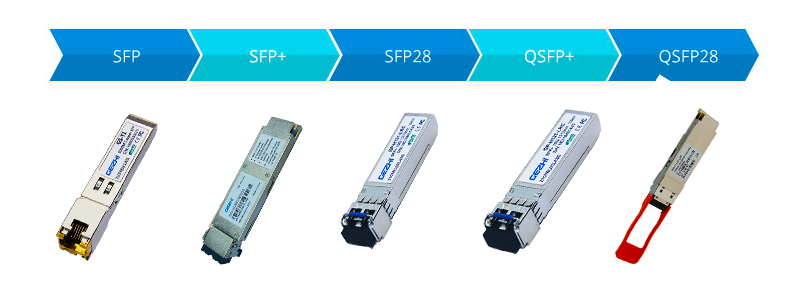
| Transceiver | Description | Data Rate |
|---|---|---|
| SFP | Small Form-factor Pluggable, is a compact, hot-pluggable network interface module used for both telecommunication and data communications applications. | Up to 4 Gbit/s |
| SFP+ | An enhanced version of SFP that supports higher data rates. It also introduces direct attach for linking two SFP+ ports without additional fiber transceivers. | Up to 10 Gbit/s |
| SFP28 | An enhanced version of SFP+ that supports a higher data rate over a single lane, making it an efficient solution for next-generation data center networks. | Up to 25 Gbit/s |
| QSFP+ | An evolution of QSFP, QSFP+ supports higher data rates over four channels. It increases port density and reduces system cost over traditional SFP+ products. | Up to 40 Gbit/s (4x10 Gbit/s channels) |
| QSFP28 | Designed for 100G applications, QSFP28 offers four channels of high-speed differential signals with data rates reaching up to 100 Gbps. | Up to 100 Gbit/s (4x25 Gbit/s or 2x50 Gbit/s channels) |
It is important to understand the unique features and capabilities of each type of transceiver to make an informed choice based on the specific networking needs. The next section dives deep into the comparison of these transceivers.
Although all these transceivers share a common purpose, each type brings unique advantages and use cases. Let's unravel the differences in terms of speed, compatibility, working principles, and applications.
SFP and SFP+ are virtually identical in size and appearance. This commonality allows network device manufacturers to reuse existing physical designs. However, they differ in terms of data transmission speed: SFP supports up to 4 Gbit/s, whereas SFP+ supports up to 10 Gbit/s. SFP adheres to the SFF-8472 protocol, while SFP+ conforms to SFF-8431 and SFF-8432. SFP+ ports can generally accept SFP modules, but the data rate will be reduced to 1 Gbit/s. Conversely, SFP+ modules should not be plugged into SFP ports as it can lead to potential damage.
SFP28 is an advanced version of SFP+ that supports higher data rates, up to 25 Gbit/s per lane. Despite sharing the same form factor, SFP28 modules have significant advantages over their predecessors. When it comes to compatibility, SFP28 can function with SFP+ optics, albeit at a reduced speed of 10 Gbit/s. Similarly, SFP+ modules can work in SFP28 ports, provided the port can be configured for 10G transmission.
SFP28 and QSFP28 vary in terms of the number of channels they support. While SFP28 supports a single channel delivering 25 Gbit/s, QSFP28 accommodates four separate lanes, each capable of transmitting 25 Gbit/s. Though both can be utilized in 100G networks, their applications differ. QSFP28 is typically used directly, whereas SFP28 is often employed in the form of QSFP28 to SFP28 breakout cables.
Both QSFP+ and QSFP28 feature four transmitting and receiving channels and share the same physical dimensions. However, they differ significantly in speed. QSFP+ modules support a maximum data rate of 40 Gbit/s, while QSFP28 modules can transmit data at an impressive 100 Gbit/s.

Understanding the differences among SFP, SFP+, SFP28, QSFP+, and QSFP28 modules gives us a clearer picture of their specific applications and future trends in data transmission technology.
SFP modules are typically used in telecommunications and data communications applications, providing an interface for network devices such as switches, routers, and fiber media converters. They are suitable for short-distance transmission, typically up to a maximum of 2 kilometers for multimode fibers and up to 120 kilometers for single-mode fibers.
SFP+, on the other hand, allows for higher data rates and longer transmission distances, making them an excellent choice for larger network infrastructure. With the help of direct attach copper (DAC) cables and active optical cables (AOCs), SFP+ modules can also enable direct connections between adjacent network switches without requiring additional fiber transceivers.
SFP28 is designed to accommodate the increasing bandwidth requirements of modern data centers. It delivers a data rate of 25 Gbit/s, providing a more energy-efficient solution compared to its predecessors. As networks continue to grow and require higher bandwidth, the adoption of SFP28 is expected to increase. SFP28 is particularly beneficial in scenarios where a single lane per fiber is sufficient, such as in direct-attach applications or short-distance connections within data centers.
Both QSFP+ and QSFP28 are designed for high-speed networks that require large amounts of data transmission. QSFP+ supports data rates up to 40 Gbit/s, making it suitable for applications like InfiniBand and Ethernet. It provides a cost-effective solution for increasing port density and reducing system costs compared to traditional SFP+ products.
QSFP28 is engineered for even faster transmission rates, reaching up to 100 Gbit/s. It's ideal for intensive applications that require high-speed data transfer, such as large data centers, high-performance computing centers, and enterprise core layers.
The relentless demand for faster data rates is propelling the evolution of optical transceivers. Newer technologies, such as PAM4 (Pulse Amplitude Modulation with 4 levels), are being introduced to improve the data rates without increasing the power consumption excessively. Moreover, efforts are underway to increase the number of wavelengths that can be multiplexed over a single fiber to maximize bandwidth. This trend of continuous advancement indicates a bright future for optical transceiver technology.
Given the diverse range of optical transceivers, it's crucial to make an informed decision when selecting the right module for your networking requirements. Here are some factors to consider:
Choose a transceiver that can accommodate your network's bandwidth requirements. As seen from our discussion, SFP+ and SFP28 support higher data rates than the standard SFP, while QSFP+ and QSFP28 are suitable for much higher-speed applications.
The transmission distance is another critical factor. Different modules support varying transmission distances - from short reaches within a data center to long-haul transmissions over hundreds of kilometers.
Ensure the transceiver is compatible with your networking equipment. While some modules are interoperable, using incompatible modules could potentially cause damage to your equipment or degrade network performance.
The price of optical transceivers can vary widely based on their capabilities. While cost is an important consideration, it should not be the only factor. Weigh the benefits of faster data rates, longer transmission distances, and higher reliability against the cost.
In conclusion, understanding the distinctions among SFP, SFP+, SFP28, QSFP+, and QSFP28 is vital to making the right decisions for your network infrastructure. These modules, each with their unique features and specifications, serve different roles in the transmission of data in various networking environments. As data rates continue to climb, the evolution of optical transceiver technology is inevitable. Stay informed, and choose wisely to build a robust, scalable, and efficient network that will serve your needs well into the future.
Optical transceivers are an integral part of our interconnected world, and understanding their specifications and applications is vital to ensuring efficient and reliable data transmission. We hope this article has been helpful in enhancing your understanding of these critical components in our networks.
Address : 5F,Zhongshunyiquan Industry Park, Fuqian Road,Longhua District, Shenzhen, China
Address : 5F,Zhongshunyiquan Industry Park, Fuqian Road,Longhua District, Shenzhen, China
Tel : +86-755-23771707
Whatsapp : +86 13544277727
Email : sales@gezhi.net
Skype : 13544277727
Copyright Gezhi Photonics Co.,Ltd. All rights reserved.


