
When seeking solutions to extend a wireless network, users often come across various hardware devices that offer similar functions, such as wireless access points (APs) and range extenders. However, these devices have distinct characteristics and use cases. This article aims to provide a detailed comparison between wireless access points and range extenders, helping users make informed decisions based on their specific network requirements.
A wireless access point (AP) is a networking hardware device that acts as a communication hub in a wired LAN, receiving and transmitting data in the wireless LAN. It provides wireless connectivity to multiple devices, such as desktops, laptops, mobile phones, and tablets. Wireless APs are commonly used in enterprise networks to extend the coverage area and support a large number of users. Advantages of Wireless APs: - Allow multiple users to access the network simultaneously, facilitating seamless roaming in campus environments. - Offer improved wireless network performance compared to range extenders, especially when deploying multiple APs. - Can be easily installed at any location with an Ethernet cable, and some models support Power over Ethernet (PoE) for streamlined connectivity. Disadvantages of Wireless APs: - Require a wired connection to a router or switch, limiting flexibility in placement. - If PoE is not available, an additional PoE switch or injector may be necessary for power supply.
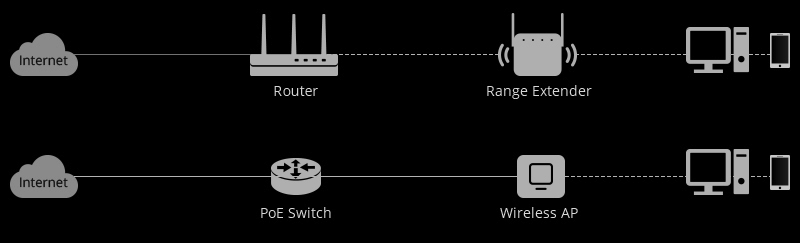
A range extender, also known as a Wi-Fi extender or repeater, is a device designed to extend the coverage of an existing Wi-Fi network. It captures the existing Wi-Fi signal, amplifies it, and then retransmits the enhanced signal, effectively extending the network's reach. Advantages of Range Extenders: - A cost-effective and easy-to-configure solution for expanding Wi-Fi coverage in small-scale applications. - Simple installation and setup process, suitable for home or small business environments. Disadvantages of Range Extenders: - Can halve the Wi-Fi speed due to the signal amplification process. - Relies on precise placement to avoid internet connectivity loss and may introduce interference in the Wi-Fi network.
To better understand the differences between wireless APs and range extenders, let's examine their key characteristics:
| Factors | Wireless Access Point (AP) | Range Extender |
|---|---|---|
| Functionality | Acts as a central transmitter and receiver of wireless radio signals, forming wireless local area LANs. | Rebroadcasts the signal from an existing Wi-Fi router to create a new set of extended service set identifiers. |
| Efficiency | No negative impact on network quality. | Available bandwidth is essentially halved due to signal rebroadcasting. |
| Cost | Relatively more expensive. | Cost-effective option. |
| Supported Area | Large businesses and offices. | Home or small business environments. |
The choice between wireless APs and range extenders depends on the specific network requirements and the intended application.
- Ideal for high-density network applications requiring high-quality Wi-Fi signals, such as large enterprises, campuses, and office buildings. - Offers superior network performance and seamless roaming capabilities. - Suitable for areas with a significant number of simultaneous users.
- Cost-effective solution for extending Wi-Fi coverage in small-scale applications, such as homes and small businesses. - Easy to install and configure, making it suitable for users with limited networking knowledge. - Recommended for scenarios with only a few Wi-Fi devices connected to the extender. In summary, range extenders are suitable for basic Wi-Fi coverage extension in small-scale environments, while wireless APs are the preferred choice for high-density network setups and areas requiring robust and seamless connectivity.
Choosing between wireless access points and range extenders depends on the specific network requirements and the intended application. Wireless access points are ideal for high-density network setups, offering superior performance and seamless roaming capabilities. On the other hand, range extenders provide a cost-effective solution for small-scale Wi-Fi coverage extension in homes and small businesses. Evaluate your network needs and consider the pros, cons, and differences between wireless APs and range extenders to make an informed decision. The right choice will ensure optimal Wi-Fi performance and coverage for your specific environment. Keywords: wireless access point, range extender, Wi-Fi network, network coverage, network performance, seamless roaming, network setup.
Address : 5F,Zhongshunyiquan Industry Park, Fuqian Road,Longhua District, Shenzhen, China
Address : 5F,Zhongshunyiquan Industry Park, Fuqian Road,Longhua District, Shenzhen, China
Tel : +86-755-23771707
Whatsapp : +86 13544277727
Email : sales@gezhi.net
Skype : 13544277727
Copyright Gezhi Photonics Co.,Ltd. All rights reserved.


