
In today's rapidly advancing digital world, data transmission demands have escalated exponentially. With the increasing need for high-speed and reliable data transfer, traditional networks face challenges in meeting the requirements of modern applications and services. In this context, DWDM (Dense Wavelength Division Multiplexing) technology emerges as a game-changer, offering a scalable and cost-effective solution for enhancing network capacity and efficiency.

As the volume of data traffic continues to surge, network operators often encounter the limitation of available fiber resources. Expanding the physical infrastructure to address this issue can be both costly and time-consuming. DWDM technology comes to the rescue by providing a means to maximize the utilization of existing fiber infrastructure.
DWDM allows multiple data streams to be simultaneously transmitted over a single optical fiber by employing different wavelengths of light. Each wavelength, known as a channel, can carry independent data, vastly increasing the data capacity of the network without the need for additional fiber deployment. This efficient use of fiber resources makes DWDM an attractive solution for operators seeking to scale their networks cost-effectively.
One of the key advantages of DWDM is its ability to facilitate transparent data transmission. Unlike other optical networking technologies, DWDM enables data to be transmitted across long distances without the need for frequent signal regeneration. This means that data can traverse the network with minimal latency, ensuring efficient and seamless data delivery.
Moreover, DWDM offers high-speed data transfer capabilities, making it suitable for handling data-intensive applications such as high-definition video streaming, cloud services, and big data processing. With each channel operating at gigabit or even terabit speeds, DWDM networks provide the necessary bandwidth to meet the demands of modern data-driven industries.
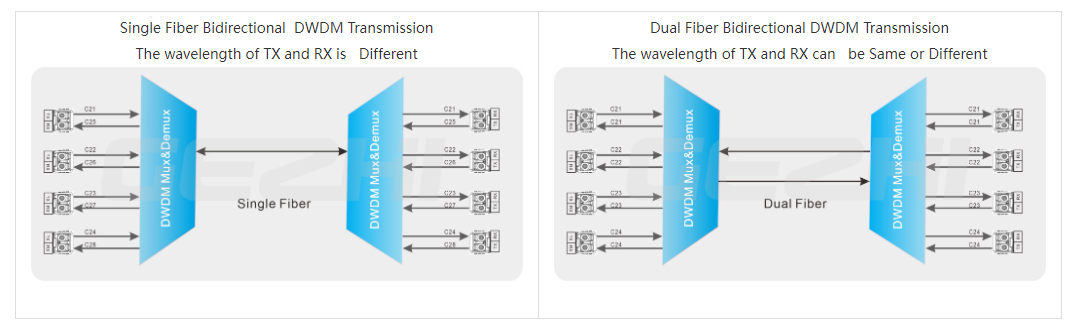
To cater to diverse network requirements, DWDM modules are available in various form factors, each offering unique advantages depending on the deployment scenario. Some common DWDM module packages include:
ABS Box pigtailed Type: A compact and cost-effective option for simple point-to-point connections or short-distance links.
ABS Cassette Plug-in Type: Ideal for use in data centers or telecommunications networks due to its modular and space-saving design.
LGX Cassette Plug-in Type: Suitable for more extensive applications, offering higher channel capacity and scalability.
19”1U Rackmount: A versatile solution for large-scale deployments, providing multiple slots for various DWDM modules.
DWDM modules are engineered with a focus on performance and reliability. Low insertion loss ensures that the signal experiences minimal attenuation as it passes through the network, maximizing data transmission efficiency. Low Polarization Dependent Loss (PDL) minimizes signal degradation caused by polarization variations, resulting in a stable and robust network performance.
High channel isolation is another critical feature of DWDM modules. It prevents crosstalk between adjacent channels, ensuring data integrity and avoiding interference between wavelength signals.
Additionally, DWDM modules are built to withstand harsh environmental conditions, making them highly reliable for long-term operation. Whether deployed in metropolitan area networks, access layers, or data centers, DWDM technology consistently delivers the expected performance and uptime.

The versatility of DWDM technology enables its application in various scenarios, including:
Line Monitoring: DWDM facilitates efficient monitoring of network traffic and enables real-time analysis of data flow, aiding network optimization and troubleshooting.
WDM Network: DWDM forms the backbone of wavelength division multiplexing networks, allowing data to be consolidated and transmitted across the network efficiently.
Telecommunication: Telecommunication service providers leverage DWDM to meet the increasing demand for high-speed data and reliable connectivity.
Data Center: In data centers, where massive amounts of data are processed and transferred, DWDM enables rapid data exchange and supports high-bandwidth applications.
As the demand for data-driven applications and services continues to grow, network operators must embrace technologies that can efficiently accommodate this surge in data traffic. DWDM stands as a reliable and scalable solution, allowing operators to leverage their existing fiber infrastructure to its fullest potential.
With its low insertion loss, high channel isolation, and excellent environmental reliability, DWDM technology empowers next-gen networks with seamless data transmission and uncompromising performance. Whether expanding network capacity or enhancing data center capabilities, DWDM is the gateway to a more connected and data-centric future.
In conclusion, DWDM has proven itself as a transformative technology in the realm of optical networking. Its ability to maximize fiber resources, facilitate transparent data transmission, and ensure high-speed connectivity positions it as a critical component of modern network infrastructures. As digital demands continue to evolve, DWDM will play an even more crucial role in supporting the data-driven world of tomorrow.
Address : 5F,Zhongshunyiquan Industry Park, Fuqian Road,Longhua District, Shenzhen, China
Address : 5F,Zhongshunyiquan Industry Park, Fuqian Road,Longhua District, Shenzhen, China
Tel : +86-755-23771707
Whatsapp : +86 13544277727
Email : sales@gezhi.net
Skype : 13544277727
Copyright Gezhi Photonics Co.,Ltd. All rights reserved.


