
The telecommunications industry has long harnessed the power of optical techniques to facilitate data transmission at an unprecedented scale. One such technology at the forefront of this revolution is Dense Wavelength Division Multiplexing (DWDM). With its ability to transmit analog or digital signals up to several gigahertz (GHz) or gigabits per second (Gbps) on a carrier of very high frequency, DWDM is truly reshaping the future of data transmission. Gezhi Photonics brings you a deep dive into this technology and its system components. Let's explore how DWDM operates and why it is a game-changer in the optical networking domain.
DWDM is an advanced variant of optical networking. By using DWDM devices, multiple optical transmitters' output can be combined and transmitted across a single fiber. The receiving end then uses another DWDM device to separate these combined signals into individual channels. This approach of employing a single optical fiber instead of a separate one for each transmitter-receiver pair is a critical factor contributing to the effectiveness and efficiency of DWDM systems.
Moreover, DWDM technology is protocol and bitrate agnostic. This feature empowers DWDM-based networks to transport data in different formats such as IP, ATM, SONET, SDH, and Ethernet, and at various speeds over an optical channel. Applications such as voice transmission, email, video, and multimedia data can be simultaneously carried on DWDM systems, making it a versatile solution for various services.
Key features of DWDM include:
| Features | Details |
|---|---|
| Protocol and bitrate independence | DWDM-based networks can transmit data in IP, ATM, SONET, SDH, and Ethernet, accommodating various types of traffic at different speeds. |
| Multiplexing ability | DWDM technology allows multiple optical channels to occupy a single fiber optic cable, thereby optimizing network resources. |
| High capacity | With advancements allowing closer spacing of wavelengths, DWDM systems are continuously improving in their data carrying capacity. |
The essence of DWDM lies in its use of Frequency Division Multiplexing (FDM). Lasers in the system create pulses of light at precise wavelengths, each representing a different channel of information. By combining these light pulses of various wavelengths, multiple channels can be transmitted across a single fiber simultaneously.
Within a DWDM system, the DWDM Mux/Demux filters play an indispensable role. These filters are responsible for combining and dividing the multiple wavelengths, all within the 1550nm band, onto and off a single fiber. When combining the signals from multiple transmitters, the optical filter, known as Mux filter, creates a composite signal.
At the receiving end, the composite signal meets an optical drop filter, or DeMux filter. This filter separates the wavelengths into individual signals, forwarding them onto respective fibers. Each individual fiber then conveys the demultiplexed wavelength to its corresponding optical receiver. Generally, Mux and Demux components - transmit and receive components - are housed within a single enclosure. This is portrayed in the diagram below.
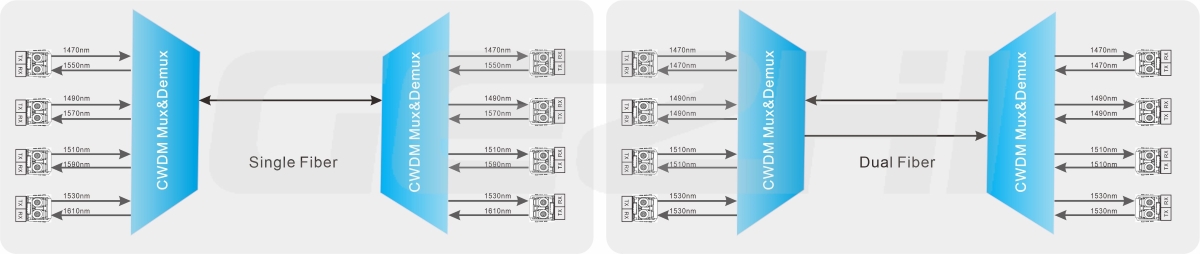
Notably, these optical Mux/Demux devices can operate passively, meaning they do not require any external power source. The signals are multiplexed and demultiplexed optically, not electronically, making the system more reliable and energy-efficient.
Optical Add/Drop Multiplexers (OADMs) also have a vital role in DWDM systems. Unlike Mux/Demux filters, the function of OADMs is primarily "Add/Drop". An OADM is specifically designed to add or drop optical signals of a particular wavelength. As displayed in the following figure, an incoming composite signal gets divided into two components, "drop" and "pass-through". The OADM "drops" the specific optical signal, forwarding it to the receiver of a client device. The remaining signals that "pass-through" the OADM are then multiplexed with a new signal, the "add" signal stream. This newly added signal, which operates at the same wavelength as the dropped signal, is combined with the "pass-through" signals to form a fresh composite signal.
When OADMs operate at DWDM wavelengths, they are referred to as DWDM OADMs, and when they operate at CWDM wavelengths, they are known as CWDM OADMs. Both variants are readily available in the market today.

Optical amplifiers are integral to the successful functioning of DWDM systems. These components boost the amplitude or add gain to the optical signals traversing a fiber by directly providing extra energy to the photons of the signal. These amplifiers are inherently "in-fiber" devices. They are capable of amplifying optical signals across a wide range of wavelengths, making them extremely valuable in DWDM system applications. The most commonly employed type of in-fiber optical amplifiers is the Erbium-Doped Fiber Amplifiers (EDFAs). When used in DWDM systems, they are occasionally referred to as DWDM EDFAs.
Various types of optical amplifiers such as DWDM EDFA, CATV EDFA, SDH EDFA, EYDFA, and Raman Amplifier are available, offering options to extend the transmission distance of your DWDM system based on specific needs.
Address : 5F,Zhongshunyiquan Industry Park, Fuqian Road,Longhua District, Shenzhen, China
Address : 5F,Zhongshunyiquan Industry Park, Fuqian Road,Longhua District, Shenzhen, China
Tel : +86-755-23771707
Whatsapp : +86 13544277727
Email : sales@gezhi.net
Skype : 13544277727
Copyright Gezhi Photonics Co.,Ltd. All rights reserved.


