
DWDM (Dense Wavelength Division Multiplexing) is a laser technology used to increase bandwidth over existing fiber-optic networks. It enables multiple signals to be transmitted simultaneously across different wavelengths, all within the same optical fiber. In a DWDM system, Mux/Demux are integral components. A Multiplexer (Mux) combines multiple data signals at the transmitting end for transport over a single fiber, while a Demultiplexer (Demux) separates these combined signals at the receiving end. These modules are used to multiplex multiple DWDM channels into one or two fibers, extending bandwidth with lower cost and longer transmission distance.
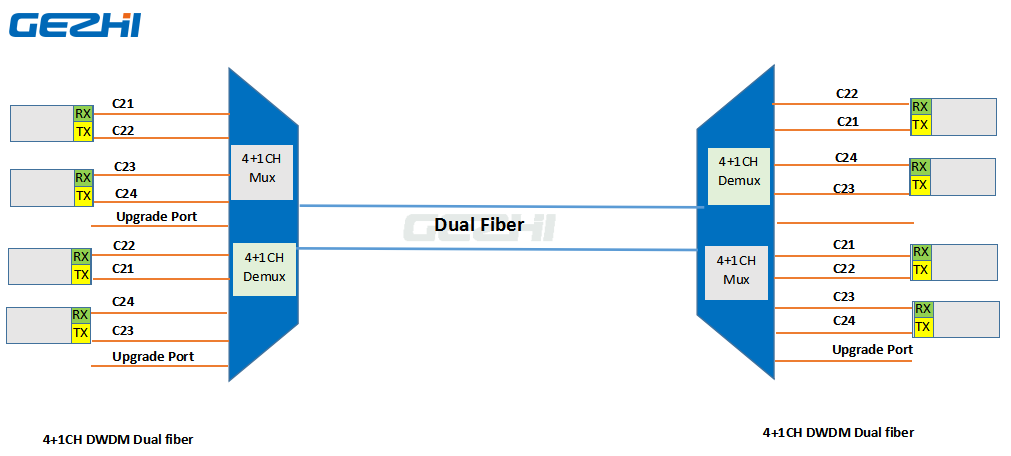
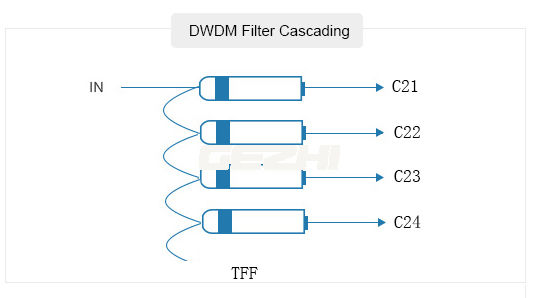
The DWDM network begins with transponders or transceivers that accept a variety of traffic types and protocols. These devices map input data to a separate DWDM wavelength. Each individual wavelength is fed to the Mux, which filters and combines multiple wavelengths onto a single output port for transmission through the primary DWDM fiber. At the receiving end, the Demux separates wavelengths, and each channel can be routed to the appropriate output through additional wavelength-matched transponders or transceivers.
Several factors are vital when choosing a DWDM Mux/Demux:
Line port is crucial for multiplexing and demultiplexing each DWDM channel. There are dual fiber and single fiber types of line ports, with the selection dependent on the use of DWDM wavelengths. Single-fiber unidirectional transmission systems are easier to design and convenient for separate wavelength monitoring. Single-fiber bidirectional systems allow transmission and reception of optical signals in both directions simultaneously, doubling the existing fiber transmission capacity. Dual-fiber systems use two fibers, transmitting signals in opposite directions, enhancing reliability as signals carried by different wavelengths do not affect each other.
Another essential port is the channel port. A DWDM Mux/Demux usually has several channel ports on different wavelengths, each working for a specific wavelength. The number of channel ports in a DWDM Mux/Demux ranges from 4 to 96, using wavelengths from 1470nm to 1625nm with a channel spacing of 0.8nm (100GHz) or 0.4nm (50GHz). More channels offer higher capacity but also come at a higher cost.
Aside from the line and channel ports, a DWDM Mux/Demux can include a monitoring port for enhanced network monitoring and management. This port allows for the testing of power, wavelength, and optical-signal-to-noise ratio (OSNR) of the optical signal without interrupting service. The monitoring port can be simplex or duplex, depending on the type of DWDM Mux/Demux used.
DWDM Mux/Demux can be divided into active and passive types, depending on the need for a power supply. Active devices require power, while passive devices do not. Passive devices are maintenance-free, upgrade-free, and do not require electricity. Passive DWDM Mux/Demux includes dispersion devices, interference devices, optical couplers, and so on. However, it lacks the OAM function and does not have protection means in case of link failure. Therefore, hybrids of active and passive DWDM Mux/Demux have been developed that combine the advantages of both and solve the shortcomings of passive devices.
DWDM Mux/Demux come in three packaging forms: 1U 19" rack-mounted, FMU plug-in, and splice/pigtailed ABS box. The rack-mounted package is easy to install, while the FMU plug-in can be conveniently used with a 19" rack chassis. The ABS box package, based on standard thin film filter (TFF) technology, occupies minimal space and can be installed in various chassis.
To improve network transmission efficiency, DWDM technology is commonly deployed. DWDM Mux/Demux is considered a cost-effective network solution with expanded fiber capabilities. Understanding its working principles and considering different factors can assist in making the best choice for your network.
When selecting a DWDM Mux/Demux, consider the following key features to ensure it meets your specific needs and requirements:
The wavelength range of a GEZHI DWDM Mux/Demux determines the number of channels that can be transmitted. DWDM systems usually have a broader wavelength range, typically from 1525nm to 1610nm, which allows for more channels and higher data throughput. Make sure to choose a system that supports the wavelength range required for your applications.
As your network grows, you might need to add more channels to meet increasing data demands. Therefore, it's important to choose a DWDM Mux/Demux that is scalable. Some devices allow for the addition of channels without interrupting existing traffic, which is a valuable feature for growing networks.
Insertion loss refers to the loss of signal power resulting from the insertion of a device in a transmission line or optical fiber. A DWDM Mux/Demux with low insertion loss ensures higher data transmission efficiency and longer transmission distance.
The quality of the components used in a DWDM Mux/Demux affects its performance and reliability. High-quality components ensure low crosstalk between channels, low insertion loss, and high isolation, leading to better overall performance.
While DWDM technology can significantly increase the capacity of your fiber network, it can also be quite expensive. Therefore, it's important to balance your budget with the specific needs of your network. Keep in mind that while cheaper devices might be tempting, they might not offer the performance or reliability that your network requires.
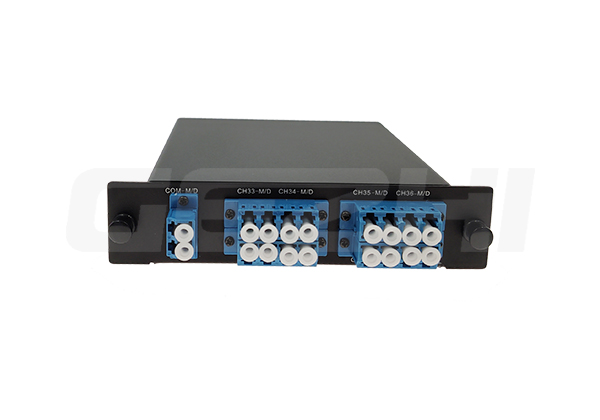
DWDM Mux/Demux finds application in a variety of areas due to its ability to increase the bandwidth of fiber optic cables. Some of its applications include:
In the telecommunications industry, DWDM systems are used to transmit multiple signals over long distances. They're particularly useful in areas where the laying of additional fiber optic cable is impractical or too expensive.
Data centers often use DWDM systems to increase their network capacity without the need for more fiber optic cable. By using DWDM Mux/Demux, data centers can transmit more data over their existing infrastructure, thereby improving efficiency and reducing costs.
ISPs also use DWDM systems to increase the bandwidth of their networks. This allows them to provide faster and more reliable service to their customers.
Large enterprises often have extensive network infrastructures. DWDM systems can help these businesses increase their network capacity without the need for more fiber optic cables. This can be particularly beneficial for businesses with multiple locations.
GEZHI DWDM Mux/Demux plays a critical role in maximizing the capacity and efficiency of fiber optic networks. By understanding its working principles and considering the right factors, you can select the best DWDM Mux/Demux for your network. However, it's also important to note that DWDM systems might not be suitable for all networks due to their complexity and cost. Therefore, it's advisable to assess your network's specific needs and consult with a network professional before making a decision.
Address : 5F,Zhongshunyiquan Industry Park, Fuqian Road,Longhua District, Shenzhen, China
Address : 5F,Zhongshunyiquan Industry Park, Fuqian Road,Longhua District, Shenzhen, China
Tel : +86-755-23771707
Whatsapp : +86 13544277727
Email : sales@gezhi.net
Skype : 13544277727
Copyright Gezhi Photonics Co.,Ltd. All rights reserved.


