
Wavelength Division Multiplexing (WDM) is a technology that provides data transmission capabilities for Optical Transport Networks (OTN). It simultaneously sends multiple wavelengths of optical signals to expand the transmission capacity of optical fibers. Two main multiplexing technologies derived from WDM are coarse wavelength division multiplexing (CWDM) and dense wavelength division multiplexing (DWDM).
WDM increases bandwidth by sending multiple different data streams in parallel on a single optical fiber network, optimizing network investment by utilizing the transmission capacity of optical fibers.
CWDM and DWDM are applicable to different network environments. CWDM is widely used in various optical fiber networks, especially in enterprise networks and telecom access networks. It is generally used in point-to-point network topologies. On the other hand, DWDM is mainly used in metropolitan area networks, data center interconnections, and financial service networks, often implemented in ring network topologies.
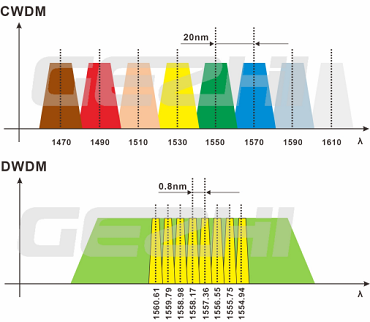
Channel spacing:
CWDM has wide channel spacing and can transmit up to 18 wavelengths in a spectral grid from 1271 nm to 1611 nm, with each channel spaced at 20 nm. In contrast, DWDM has a narrower spacing of only 0.8/0.4nm (100 GHz/50 GHz grid) and can carry 40, 80, or up to 160 wavelengths in the wavelength range of 1525 nm to 1565 nm (C-band) and 1570 nm to 1610 nm (L band).
Transmission distance:
Due to the highly integrated DWDM wavelength with the optical fiber during transmission, the transmission distance of DWDM can exceed that of CWDM. The maximum transmission range of CWDM is about 160 km, while amplified DWDM systems can transmit over longer distances.
Laser type:
CWDM uses uncooled lasers, while DWDM uses cooled lasers. Cooled lasers in DWDM systems are temperature-tuned to ensure better performance and longer system life but consume more power.
Cost:
Due to the requirement of cooled lasers, DWDM systems are relatively more expensive. However, with the popularization of DWDM technology, the price of DWDM transceivers has dropped and is now about 20-25% cheaper than CWDM transceivers.
Advantages and disadvantages:
CWDM and DWDM have their own characteristics in terms of advantages and disadvantages. CWDM has advantages such as low power consumption, small space requirements, flexibility on cable types, larger payload per channel, smaller and cheaper filters, and savings in start-up and expansion costs. However, compared to DWDM, CWDM has a relatively smaller bandwidth capacity and transmission range. On the other hand, the biggest advantage of the DWDM system is its largest system capacity and the farthest transmission distance. However, it requires more space, more power, high-precision lasers and filters, and expensive amplifiers.
Generally, both CWDM and DWDM are effective means to increase data transmission bandwidth and each has its own advantages in different application scenarios. With the continuous increase in bandwidth demand, DWDM is becoming more popular and has made significant progress in cost reduction. However, for applications with lower data rates and shorter distances, CWDM still has a price advantage. Therefore, CWDM and DWDM will complement each other and develop together in the future OTN network, rather than replacing each other.
Address : 5F,Zhongshunyiquan Industry Park, Fuqian Road,Longhua District, Shenzhen, China
Address : 5F,Zhongshunyiquan Industry Park, Fuqian Road,Longhua District, Shenzhen, China
Tel : +86-755-23771707
Whatsapp : +86 13544277727
Email : sales@gezhi.net
Skype : 13544277727
Copyright Gezhi Photonics Co.,Ltd. All rights reserved.


