
In DWDM technology, data is simultaneously transmitted in the form of optical signals of multiple wavelengths in the optical fiber network, thereby increasing the bandwidth of the network and improving the speed and channel capacity of data transmission. DWDM Mux Demux and DWDM Transceiver are essential components in DWDM transmission.
Therefore, for high-quality DWDM transmission, it is very important to choose a suitable optical transceiver. This article will provide you with the answer.
In DWDM Mux Demux, the optical transceiver of the common port is required
The common port plays a key role in the DWDM Mux Demux, which is responsible for connecting the external optical fiber with the line port of the Mux Demux and multiplexing and demultiplexing the channel ports of different wavelengths. When selecting the transceiver modules corresponding to these two ports, wavelength and transmission distance are two key factors to be considered.
Selecting Transceivers: DWDM Based Wavelengths
Usually, the commonly used frequency band of 100GHz DWDM is C21~C60. For example, the wavelength range of GeZhi Photonics' 40CH DWDM Mux Demux is also C21-C60. According to this, we can choose the matching optical module. If you don’t need to use all 40 channels of Mux Demux, we can give priority to low-frequency optical modules, such as C21, C22, C23, etc.
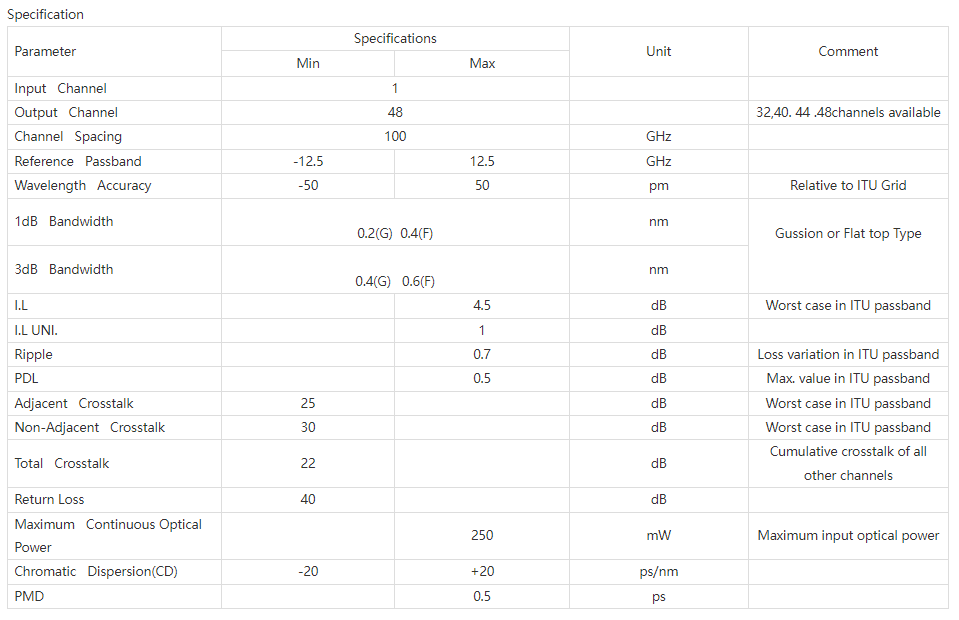
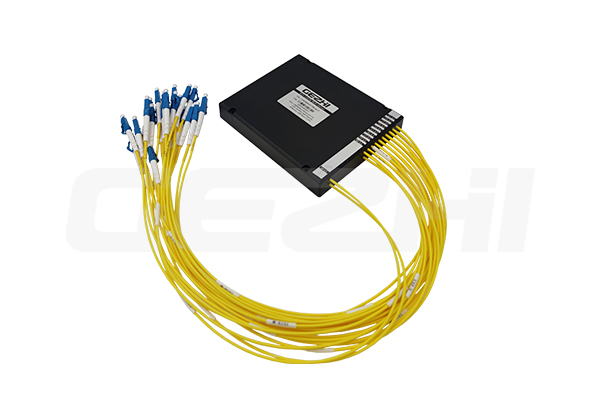
For 16CH DWDM Mux Demux and 8CH DWDM Mux Demux of GeZhi Photonics, the common frequency bands are C21~C36 and C53~C60. The transceiver selection method of these devices is similar to that of 40CH DWDM Mux Demux, except that the frequencies are arranged from low to high. It is worth mentioning that the frequency bands of C53~C60 can be connected with the 1530nm channel port in the CWDM system, so as to upgrade the DWDM service on the CWDM system.
Select optical module: based on transmission distance
We all know that in all transmission processes, there are optical losses caused by equipment and optical cables. Therefore, the actual transmission distance of the DWDM optical module is usually shorter than the nominal transmission distance of the module, which is especially obvious in the aging optical fiber transmission system. If necessary, the transmission distance in the DWDM network can be extended by adding EDFA and DCM equipment.
When faced with different transmission distances, power budget planning needs to be carried out in advance. Taking 10G network as an example, the maximum insertion loss of GeZhi Photonics' 40CH DWDM Mux Demux is 5dB. A complete point-to-point transmission link requires two DWDM Mux Demux, so the total insertion loss is 10dB. And the 10G 80km DWDM mode of GeZhi Photonics
The transmission power of the block is 0~5dBm, and the receiving sensitivity is -24dBm, which means that the module can support a maximum transmission distance of 80km without using any amplifier.
So what if your transmission distance exceeds 80km? This requires the use of EDFA (erbium-doped fiber amplifier) and DCM (dispersion compensation module) to improve the transmission distance. EDFA can improve the signal strength in the optical link, and DCM can be used to compensate the dispersion of the optical signal in the process of propagating in the optical fiber, thus effectively improving the transmission distance and signal quality.
Summarize
When selecting a DWDM transceiver, wavelength and transmission distance are two key factors. By properly selecting the wavelength and selecting the appropriate optical module according to actual needs, the DWDM system can better meet your needs. Of course, if the transmission distance exceeds the nominal distance of the optical module, you can also use devices such as EDFA and DCM to increase the transmission distance.
While understanding the potential of DWDM and optimizing its component selection, let us also bear in mind the fact that every network environment is unique, so understanding your own network needs and limitations is critical when deciding on a DWDM solution. While this article gives you some direction, the final decision should be based on your specific circumstances.
Address : 5F,Zhongshunyiquan Industry Park, Fuqian Road,Longhua District, Shenzhen, China
Address : 5F,Zhongshunyiquan Industry Park, Fuqian Road,Longhua District, Shenzhen, China
Tel : +86-755-23771707
Whatsapp : +86 13544277727
Email : sales@gezhi.net
Skype : 13544277727
Copyright Gezhi Photonics Co.,Ltd. All rights reserved.


