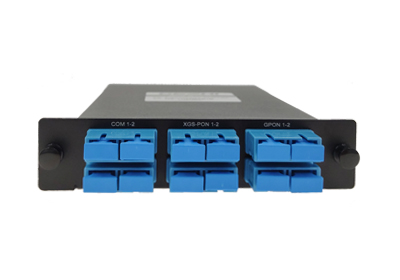

DWDM over CWDM Device (DWDM & CWDM Bandpass Component)
There are two types of wavelength division multiplexing (WDM) standards: CWDM - coarse wavelength division multiplexing, and DWDM - dense wavelength division multiplexing. CWDM used to be a more popular low cost entry point for many customers for the GbE rates, due to the difference in economic scale (typically a third of the cost of the equivalent DWDM optics), limited budget, and typical initial requirements not to exceed 8 wavelengths. As the need for capacity grows and service rate increases to 10G/40G/100G, there is a demand to increase the capacity of existing CWDM networks.
CWDM and DWDM (100Ghz grid) channel width comparison

Growing capacity through adding DWDM wavelengths onto CWDM wavelengths fiber

Features | Applications |
|
|
Specification
| Parameter | Specification | |
| Pass Wavelength (nm) | DWDM band 1520~1565 | |
| Reflect Wavelength (nm) | CWDM band 1260~1515 & 1570~1650 | |
| Pass Channel Insertion Loss (dB) | ≤0.6 | |
| Reflection Channel Insertion Loss (dB) | ≤0.4 | |
| Isolation (dB) | Pass Channel | >30 |
| Reflect Channel | >15 | |
| Polarization Dependent Loss (dB) | <0.20 | |
| Polarization Mode Dispersion | <0.1 | |
| Directivity (dB) | >50 | |
| Return Loss (dB) | >45 | |
| Maximum Power Handling (mW) | 500 | |
| Operating Temperature (℃) | -10~+75 | |
| Storage Temperature (℃) | -40~+85 | |
| Package dimension (mm) | Φ5.5 x L35 or Customized | |
Ordering Information
Address : 5F,Zhongshunyiquan Industry Park, Fuqian Road,Longhua District, Shenzhen, China
Address : 5F,Zhongshunyiquan Industry Park, Fuqian Road,Longhua District, Shenzhen, China
Tel : +86-755-23771707
Whatsapp : +86 13544277727
Email : sales@gezhi.net
Skype : 13544277727
Copyright Gezhi Photonics Co.,Ltd. All rights reserved.